Day 5
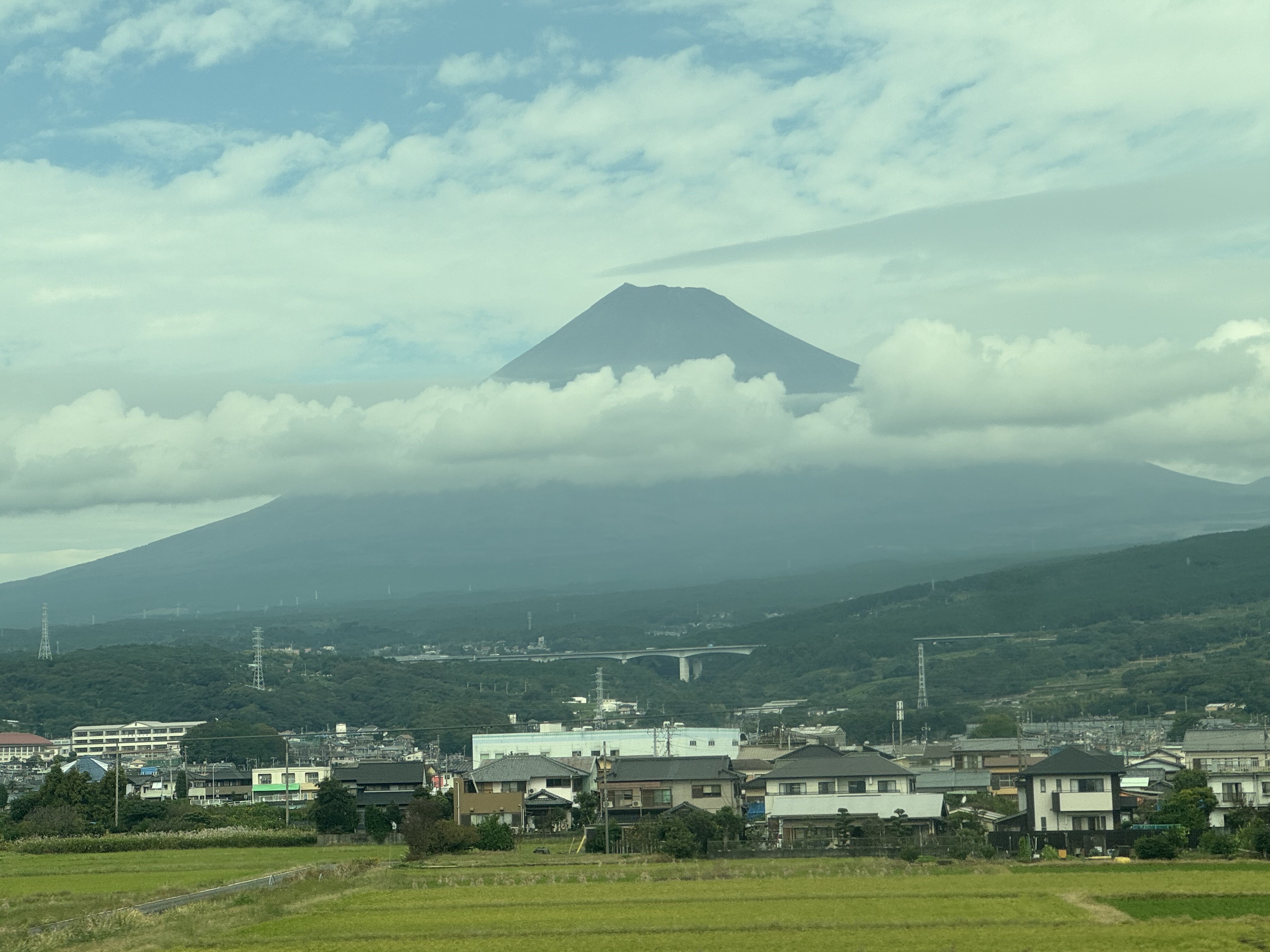
The next morning, we set off early for the next leg of our journey through Japan, which began by boarding a Shinkansen (bullet train) from Tokyo Station to Kyoto. We bought a bento box for breakfast to take with us on the train and, as we consumed it, we wondered where the outer limits of Tokyo might lie. As the scenery flashed past at speeds approaching 300 km/hr, we enjoyed striking views of Mt Fuji which was, uncharacteristically, uncapped by snow.
Our accommodation in Kyoto was surprisingly spacious. It was a traditional flat above an electronics store, with a shared kitchen and a wrap-around deck that was mostly taken up with sheets hung out to dry. It also featured a small table with a single chair. A chair is a truly precious object for weary walkers looking to enjoy a beer and seaweed crackers at the end of the day. Unfortunately, however, there was only one chair. Inside our beautiful flat, there were two seats at floor level. We tried to ignore the effort involved in getting up and down from the floor many times a day, but how could we ignore it as we flailed our limbs around to gain enough momentum to launch ourselves upright, making what our daughters would call “old people noises”?
We chanced on a small ramen joint for lunch. Susie had tofu and seaweed and Jordo tried the standard Japanese ramen. (The broth was so good that we re-traced our steps back there a couple of days later to enjoy the experience a second time.) The rain set in after lunch, so we headed back to the flat for a quiet night, knowing that we had dinners booked for the following three nights.
Day 6
The rain continued all night and greeted us in the morning as we made our way to Keage train station to meet Andrew, a tour guide who we had booked to show us around some Japanese gardens. He told us the tour would go ahead even if it rained. When we met him at the appointed place and time, however, it was clear that a tour was impossible. The unrelenting rain was hammering down. He suggested we double up with an American couple the following Monday. We would no longer be able to enjoy the private tour we had arranged, but we would not have to miss out altogether. Andrew also rescued the afternoon by recommending some sightseeing that we could do from indoors. So, we headed off with a new itinerary.
The first venue was Chishakuin. This is a Buddhist institution (HQ of a key Buddhist sect and currently a training centre for monks) surrounded by exquisite gardens that can be viewed from within the building, and from covered walkways that connected the various structures within the compound. The gardens looked lovely in the rain and, best of all, there was almost no-one else there. One room had a large space covered with tatami mats that opening out onto one of the many gardens. We stopped there to enjoy the peaceful ambience created by the “constructed nature” laid out before us. If we did not have two more destinations to explore, we might have whiled away the rest of the afternoon there.
The next stop was Sanjusangen-do. This is a long, wooden hall housing 1,001 golden statues of the Buddhist deity, “Kannon”.124 were made in the 12th Century when the temple was founded and 876 when it was renovated in the 13th Century. There were many more tourists there, but again, we were out of the rain, and the architecture was just as fascinating as the exhibits that it contained. The informative signage drew connections between the intricate statues and the prolific pantheon of Indian mythological figures from which many had been derived. Sadly, photos were not allowed.
At the end of the day, down a small side street, we located the home of 20th century master potter and leader of the folk art movement, Kawai Kanjiro (1890 – 1966). The house still looks comfortable, homey and inviting, and it illustrates the wabi sabi approach design and living. Susie marvelled at the ceramics, and we both drooled over the design of the living spaces and furniture. A pamphlet from the museum describes Kawai Kanjiro: “throughout his life he retained that abounding freshness found in curious children, he found interest in all surrounding him and released his creative energy through his art regardless of pubic criticism or approval. He was humble and compassionate.
[Degustation at Giro Giro Hitoshina]. Tiny restaurant behind a curtain. Fitted no more than 10 customers, had 5 o6 staff and produced a delicious degustation dinner.
Day 7
The next day, rain gave way to sunshine, and we took an outing to Fushimi Inari Taisha. This destination was recommended by our friends Steph and Terry, who had recently honeymooned in Japan. It is a complex of Shinto shrines with a pathway that leads through a thousand red Tori gates as it winds up a mountain. It’s a popular destination, and tourists (both local and international) flocked there to enjoy the sunny weather and the cool shade afforded by the surrounding pine forests. Our progress along the path often slowed to a shuffle due to the crowding. The mood was friendly and festive, however, and several stops along the path afford panoramic views of the city of Kyoto below.
[Dinner – chef’s choice – Sumibi to Wine Karasuma]
Day 8
We met up with Andrew again for our postponed tour of Japanese gardens. It was centred on the complex of Nanzen-ji Temple, head temple of the Rezai sect of Zen Buddhism. Tenjuan is one of the most important temples of the Nanzenji. The garden dates from 1337, although some parts were remodelled in later years. It was a treat to sit back and study the rocks, gravel and plants that make up these tableaux while listening to Andrew describe the elements and their arrangement, and the lessons they encode for the monks who live among them. He explained how the elements of one garden referred to a myth about a mother tiger who had to carry her cubs across a river without letting any be eaten by a voracious sibling. The story was a lesson in problem solving, he said. Our tour ended at a famous aqueduct. From there we took leave of our guide and made our way to a Geisha performance in Gion Odori. Susie had gone to some lengths to secure tickets to this event, and the effort paid off.
The performance took place in a spacious auditorium. On the left-hand side, close to where we sat, a row of women sang, and played the shamisen (a three-stringed Japanese lute). They appeared to have a similar role to the chorus in a Greek play, providing narrative for a drama enacted by heavily made-up actors on a central stage. The story involved an ambush in a forest, highly stylised sword fights, and confrontations with authority. Beyond that, we found it quite mysterious. The performers wowed the audience, which was overwhelmingly Japanese. We left satisfied, having experienced an artistic form that was traditional, formally beautiful, and distinctly Japanese.
In the evening, we met up with a friend called Virginia. She was staying for a month in Kyoto to improve her Japanese. Our mutual friend Robbie was keen for us to connect, and it was a pleasure to find a familiar face in a bustling city. We met her outside a department store and then settled into a restaurant to catch up. The time flew past, and soon we had to return to our Kyoto flat to pack for our next destination—Hiroshima.
 Wundercliffe